Google
 

Tuesday, August 14, 2007

Education in Action

Students in Free Enterprise (SIFE) is a very unique organization. Our La Sierra University SIFE team is no exception. Upon examining the way we model our budget and funding, you may see us as a non-profit organization. Speaking to other groups on campus you may see us a club. Community organizations see us as a partner. Those affected by our projects see us as their friends. But what is SIFE to those within the organization itself?


One of the best ways to describe our experience is service-learning. What good is an education if it is not applied and utilized? As students, we are often impatient upon learning new things. We get so excited about the new things that we learn that we immediately want to begin using our new knowledge, skills, and abilities in the world around us. SIFE is for that kind of student. We want to do something with our lives, but we still recognize that we are students of life, for life.


The National Youth Leadership Council has a great explanation of Service-Learning:

"Picking up trash on a riverbank is service.

Studying water samples under a microscope is learning.

When science students collect and analyze water samples, document their results, and present findings to a local pollution control agency … that is service-learning.

Service-learning is a teaching method that enriches learning by engaging students in meaningful service to their schools and communities. Young people apply academic skills to solving real-world issues, linking established learning objectives with genuine needs. They lead the process, with adults as partners, applying critical thinking and problem-solving skills to concerns such as hunger, pollution, and diversity."

It's a great model that makes great sense. It involves the same building upon strengths that exists at the heart of our village-building project. Far too often, when seeking a way to be kind or charitable, we engage in activities that may help others without being at all useful to ourselves. Or perhaps we buy a handful of bookmarks or other items not of much use to us because the proceeds go to a good cause. SIFE takes a different approach. We believe that it is perfectly possible to develop sustainable win-win situations by using basic, time-tested concepts of the free-market econonomic system.

By working on SIFE projects which greatly benefit others, I myself greatly benefit in terms of the amazing and unique experiences which result. Application is not just a welcome supplement to education, it is an intricate part of education itself.

"Service-learning is education in action." — Sen. John Glenn

Friday, July 20, 2007

Focus

One of the most difficult things when preparing to work on a project like this is access to accurate information. There are so many individuals and organizations out there sharing their take on what is happening in Sudan. When it comes to issues around the globe, outside entities and nations often display inaction followed by incorrect action.

As a college student preparing to join the village-building effort, my views began very emotionally-charged. The difficult reality here is that I am not a government or a military. I am a student. I want to help build homes for people who have none. So that is where the focus must lay. Outside organizations that try to work in Sudan often find themselves kept out because in addition to a focus on something like building homes or providing aid, they also launch charged political actions.

In relation to work in Sudan, many organizations and individuals play many different roles. But again, the reality here is that we cannot enter any country we wish and begin achieving our goals immediately. History has shown us that diplomacy actually resolves situations far more quickly than aggression. Whenever possible, we must work with all parties involved to make the accomplishment of our goals as sustainable as possible. For us, that means maintaining a focus on building sustainable villages, and not imposing Western ideas on the villagers for example.

To find a little clarity of information regarding Sudan, I would recommend The Root Causes of Sudan's Civil Wars by Douglas Hamilton Johnson. It is often given particularly to diplomats and government officials who need to understand the big picture of Sudan's history and environment. I found it a little biased in favor of the south, but overall, it was very useful.

World Changing

Doing a little research for more village building ideas, I came across a very interesting site called worldchanging.com. In my experience with SIFE and our project partners, I have found that often all of the resources and tools we need already exist. What it really comes down to is true passion and cooperation. This is true of the world as a whole and any organization you are a part of. There are often multiple individuals, departments, organizations, or entities doing almost exactly the same thing and all get things about halfway done. It takes much more than just having a common goal. It takes the realization that the goal is common with your own. To tackle the problems of this world, it takes real connectedness.

This is why I was excited while spending some time tonight searching about how others are working to make a difference. It was refreshing to see the worldchanging.com view

"WorldChanging.com works from a simple premise: that the tools, models and ideas for building a better future lie all around us. That plenty of people are working on tools for change, but the fields in which they work remain unconnected. That the motive, means and opportunity for profound positive change are already present. That another world is not just possible, it's here. We only need to put the pieces together."
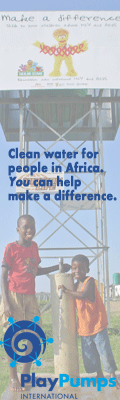
There are some very interesting possibilities to use in the village that I'm finding on that site, but there's also potential for use with many other projects. I'm also checking out the grants available from the Case Foundation who have been a great help in the PlayPump 100 pumps in 100 days campaign. The campaign raised enough for 111 pumps. I have rarely seen fundraising efforts exceed their goals like this before. It is such a great idea. Now 250,000 people will get access to clean drinking water.

Wednesday, July 18, 2007

From Conflict to Community

It is incredible to have the opportunity to work with American Sudanese Partnerships. It is rare for an organization to be allowed to operate particularly in the Darfur region. I honestly thought that I would have to spend at least twenty or thirty years in a government job to be able to be involved in something like this. This year has really changed my perspective on what students can do in the world. It has been a real inspiration to our SIFE team and other teams we have come in contact with. Check out the American Sudanese Partnerships blog for a great read as things develop further.

American Sudanese Partnerships: Winter in Khartoum and Darfur


The next thing we'll be working on in SIFE with this is to turn the documentation into a business case study so people can help us further develop our economic development plans to accompany the building of the villages. We are looking at using several ideas already very successful in our work with Kalaala, Ethiopia, a village our SIFE team has been working with in cooperation with the International Medical Aid Association. You can read more about that project here Projects or the video below about our SIFE Water project where 100% of the profit directly benefits the village in Kalaala.


Once we turn it into a case study, we will be seeking to involve other colleges and universities and especially you, the reader, in coming up with new ways to have a sustainable impact in the villages in Darfur. My favorite concept so far has been the PlayPump system mentioned in the previous post. When you don't have unlimited resources and modern technology to work with, which is usually the case, it becomes important to conduct thorough analysis, and build upon existing strengths. We have lots of earth to work with, so we build homes primarily out of it, children love to play and people need clean water so the PlayPump was developed, the list goes on and on.

One of the most important things our team has come to realize while developing ideas is the concept of home. It is incredible to be able to help people build new homes that are strong, long-lasting, energy efficient, and even attractive. Having a home is about much more than just a roof over your head. Right now, the "luckiest" displaced families in the refugee camps live under tents made primarily of plastic sheeting given to them by the U.N. or aid groups. The sheets are often mixed with scraps of cloth in an attempt to made a more resistant structure. The camps are filled with these shelters.

What we now have the opportunity to do is go far beyond plastic tents. When considering building villages anywhere in the world, Darfur may be the last place most people would recommend, but the need is greatest there. After the first village is complete, it will serve as a model of what is truly possible in the world. The first village network will have an estimated 1,500 eco-dome homes, a school, a hospital, and an entire infrastructure in conjunction with the National Unity Government and local officials. We plan to start the bulk of economic development focused on agriculture and potential future construction. In essence, we are forming an entire economic system for the area, drawing from knowledge even further than what we are learning in our classes. We work on all of this in the hope that it can be applied all around the world, especially in areas people have often already signed off as a lost cause.

Tuesday, July 17, 2007

Earth, Water, Wind, Fire in the Hole

In addition to building a model village to demonstrate the strength and attractiveness of the 90% earth building method, we are constantly exploring and experimenting with new ideas for possible application to the villages in Darfur.

One of the things I came across about a year ago was the PlayPump system.


It is such a great idea. It is in essence a merry-go-round / water pump. It has been an incredible success in the southern African countries where is has been used so far. For example, at schools, teachers would often come at four or five in the morning to get water from a well or use a hand pump for the children to use during the day. Now, the kids can play on the PlayPump and fill up the water storage tank. The system goes deeper than a normal well allowing access to cleaner water and pumps 10 times faster than a hand pump. The company that sets the system up is in South Africa, but I am working on getting a system started up at our model village at La Sierra University and hopefully the real villages in Darfur very soon. Check out the interactive card below. For some reason, you can only view it using Internet explorer and sometimes you have to refresh the page (hit F5) if it stops loading, but give it a try.


Once we finish our first few test domes, we may build the complete eco-dome with all the things included in a modern home. We are looking at testing out a new windmill power system design at our model village. Each one will provide about a megawatt of power per day.

We may actually make full use of a PlayPump system for some small-scale agricultural testing. La Sierra University gave us a pretty large piece of land to work with, so we can now try out many new ideas. We are looking at using the area you can see in front of Arbee who is operating the cement mixer in the photo. Just imagine what this photo will look like with the completed village and colorful plants and flowers. I'm actually heading out to Hawaii in a few hours. I'll be meeting with some groups about ideas for agriculture at Fire in the Hole (our village).

The Cal-Earth Institute has come up with great ideas in their experience with this building method. Building upon strengths, using what you have to work with, these concepts have been life changing. Seemingly useless things suddenly have incredible uses, useful things have even more potential uses. For example, following Cal-Earth, we use a simple dog leash stake connected to a chain to serve as a compass to show us how much to come in on each layer to form the correct dome shape with engineering precision. We also use simple pvc pipe as forms for the windows. We just lay a line of filled bag over the pipe and knock the pipe out after we finish a few layers on top of it.

Thursday, July 12, 2007

A dome begins

A few people have sent in questions about how we start building the domes. Below is a short time-lapse we made a few months ago of the first 1-2 layers of our first dome (the one in the pictures from the last post).

Keep the questions coming, it will drive the blog content from now on. You can also purchase some great books from the Cal-Earth Institute regarding the construction process and the potential use of these structures.


Google